Two Weeks Later, and I Am Still Celebrating: Why Washington's Menopause Workplace Executive Order Deserves More Than a Headline by Quiana Daniels


Here is something I have noticed about important news: it often arrives hot off the press, makes the headlines for a day, and then quietly fades while the next story takes its place.
I do not want that to happen to the menopause workplace accommodations initiative!
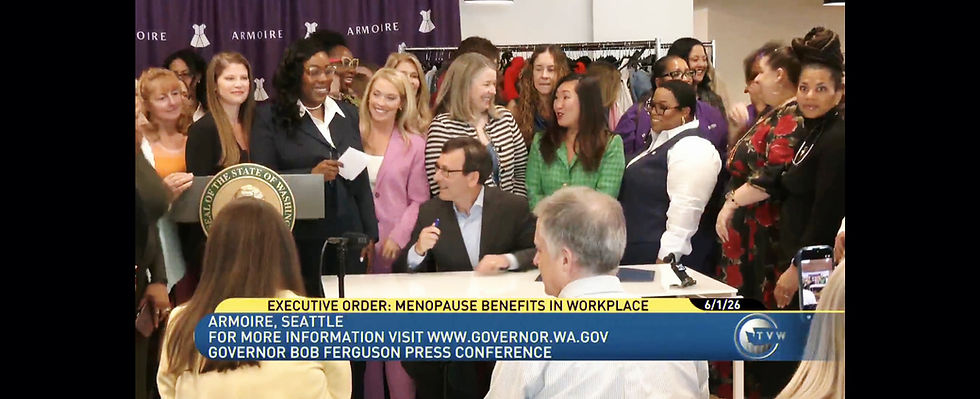
Two weeks ago, on June 1, 2026, I had the honor of standing beside my fellow Washington State Women Commissioners, supporters, and Governor Bob Ferguson as he signed Executive Order 26-01, making Washington a national leader in supporting women experiencing perimenopause and menopause in the workplace. The cameras were there. The headlines ran. And now, as predictable as ever, the news cycle has slightly moved on.
But the women this order was written for have not moved on. They are still at their desks, still pushing through hot flashes, brain fog, and sleepless nights, still wondering if they are the only ones. So, let me do something a little different today. Instead of marking the moment and letting it go, I want to keep the momentum going.
Why Menopause Work Accommodations Matter to Me?

I serve on the Washington State Women's Commission as a Health Committee member, and I have spent more than two decades as a nurse in women's health. I have sat with women in some of the most tender and overlooked seasons of their lives. And menopause, despite touching every woman who lives long enough to reach it, remains one of the most under-discussed and under-supported of them all.
That silence has a cost. Too many capable, experienced women have quietly stepped back from leadership, reduced their hours, or left work altogether, not because they lost their talent, but because the workplace was never built with their bodies in mind.
What makes this Executive Order powerful?
What I love about EO 26-01 is that it does not just acknowledge the problem. It organizes the state to do something about it.
It directs our Commission to work alongside state agencies to develop practical workplace accommodations and to build guidance and training resources for employers across Washington. We are talking about real, common-sense support: flexibility, temperature control, and a workplace culture that treats menopause as a normal stage of life rather than something to hide. Countless hours were put in by the Health Committee to ensure i's were dotted. t's were crossed and equitable representation echoed throughout this mission.
That is the difference between a nice gesture and a structural change. This is structural.
The lens I carry
As a woman, mother, nurse, healthcare leader and business owner, I think about the full arc of a woman's life, from fertility and pregnancy to postpartum recovery and beyond. Menopause is part of that arc, not a footnote to it. When we build workplaces that honor women through every season, we do not just retain talent. We tell women they belong, fully and without apology.
That belief is woven into the work I do every day at Childress Nursing Services, and it is the same belief I carry into every room I am privileged to sit in.
A proud note on the company I keep

I was honored to be at the signing alongside fellow members of the Women's Commission and, in my work beyond it, to stand with my colleagues on the Washington State Board of Nursing and the many nurses who pour themselves into caring for our communities. Wearing my Childress Nursing Services scrubs that day was intentional. Nurses belong in these policy conversations, because we see firsthand what happens when systems forget the people they are meant to serve.
Let's keep the momentum going
So here is my ask... Do not let this fade.
If you are an employer, start the conversation about menopause accommodations now, before guidance is even finalized. If you are a woman navigating this season, know that you were seen on June 1st, and you are still seen today.
And if you simply believe women deserve workplaces built for their whole lives, share this.
Talk about it.
Keep it alive.
I always say,
"Helping Others Heals Us!"
~Quiana Daniels
I believe that with my whole heart. Washington took a meaningful step on June 1. Let's make sure it is remembered as the beginning of something, not a headline that came and went.


Comments